Local AI: reports and release notes
KeelOps knows what was done, by whom, for which customer, in which week — because the work lives in it: tasks closed, hours logged, tickets answered, deals moved. A language model running on your own server can turn that into documents people actually read: the release note for your users, the monthly report for the administration, the week's summary for the sales meeting. Nothing leaves the building: the model is an Ollama instance on your network, and the SDK talks to it through ollama.mjs.
What KeelOps already does with it
These features are part of KeelOps itself. They are the pattern a plugin follows, and the proof that it works on real data.
- Release notes of a project. From the project page, pick the status (released, say) and the week: out comes a Word document, by email, with an opening paragraph that separates new features, fixes and internal work, and one entry per task, written for the person who uses the product — not for the developer who closed the task.
- The newsletter for users. The same material, week by week, across the projects of a product, in the Report view of the timesheet. The example below went to the users of a real product.
- The task map (a plugin, TasksMap): the themes of a project's tasks, read from their text with embeddings, drawn as a graph — see Pages.
- Estimates from similar work: when a task is opened, the tasks that most resemble it, and how many hours those took.
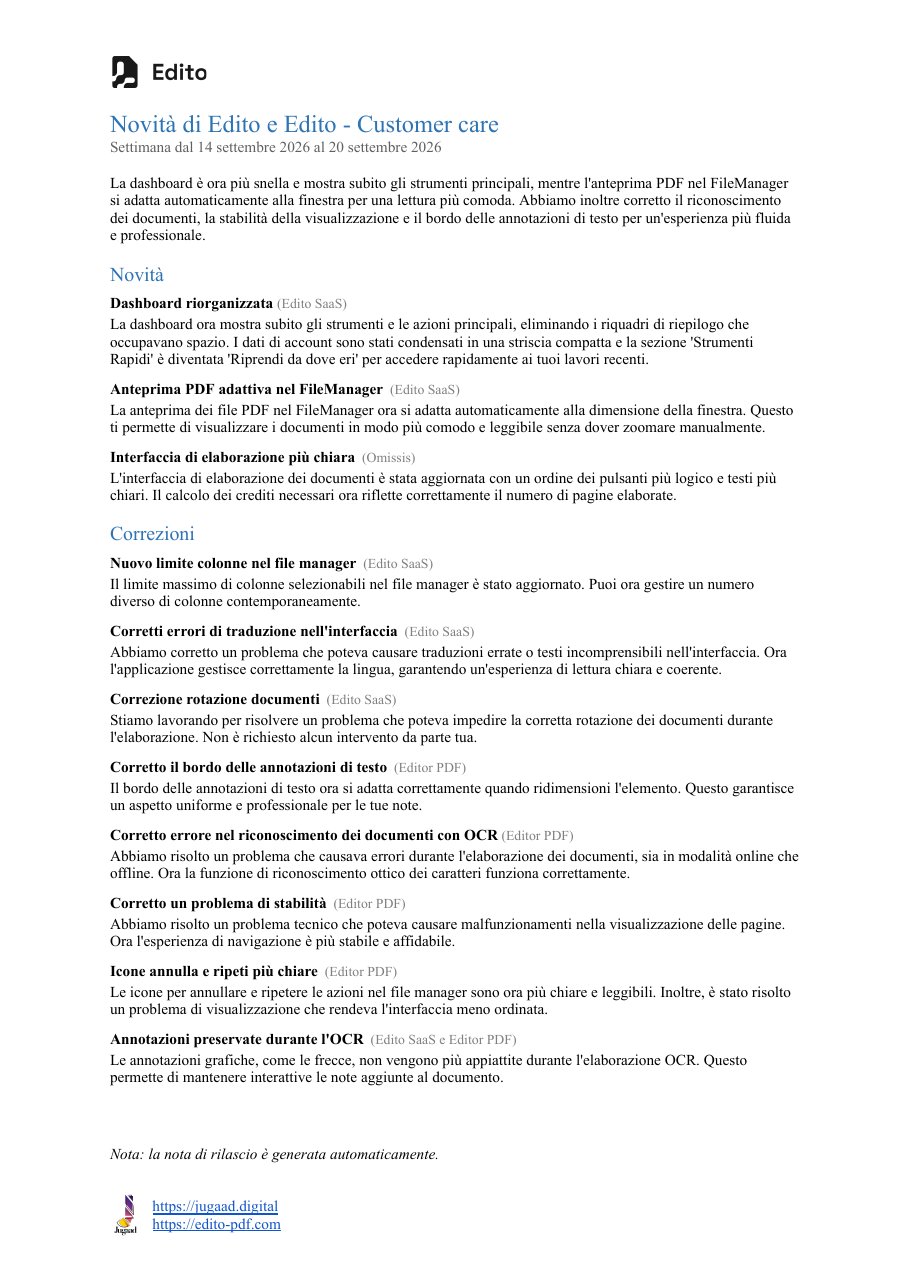
A weekly newsletter produced by KeelOps from the work closed in the week (Italian, as it went out): an opening paragraph, then Novità (new features) and Correzioni (fixes), each entry with the product it belongs to, and the note that it was generated automatically.
What a plugin can build
The same pattern serves anyone who has to account for work:
| for | the document | from |
|---|---|---|
| users of a product | the weekly or monthly release note | tasks entered in a released status in the period |
| the administration | the month of a customer: requests opened, work done, hours per activity, in plain words | TimeEntry, Task (kind = 'TICKET' and project work) for a Company |
| sales | the week's pipeline: what moved, what is stuck, what is worth a call | Task with kind = 'DEAL', their stages and values |
| the quality team | the month's non-conformities and the actions that closed them | the plugin's own tables, plus the core tasks they point to |
| the team | the retrospective of a project over a window of time | tasks opened and closed, messages, documents |
The model writes the prose. It does not decide what goes in, and it does not decide the numbers.
The pattern
- Gather with SQL, deterministically: which tasks, which hours, which customer. The model never chooses the material.
- Group with rules, deterministically: which section an entry belongs to is decided by its status or its type, not by the model. A cancelled task among "what we delivered" would be a lie in a document that goes to a customer.
- Ask the model only for sentences, one entry at a time, with a JSON schema for the answer.
- Write the document with the numbers from step 1 and the sentences from step 3.
- Without a model, the document still comes out — with the task titles in place of the sentences — and says so.
Talking to the model
import { chat } from "…/keelops-sdk/ollama.mjs";

const SCHEMA = {
  type: "object",
  properties: {
    title: { type: "string" },
    text:  { type: "string" },
    kind:  { type: "string", enum: ["feature", "fix", "internal"] },
  },
  required: ["title", "text", "kind"],
};

async function entryFor(task, model) {
  const answer = await chat({
    url: ctx.ollamaUrl,
    model,                                   // a setting of the plugin, e.g. "qwen3:14b"
    system: "You write release notes for the users of a software product. " +
            "One short title and one or two sentences, for someone who uses the product, " +
            "not for the developer. Say only what the task says. Answer in Italian.",
    user: `Task: ${task.title}\n\n${stripHtml(task.description).slice(0, 2000)}`,
    schema: SCHEMA,
    numPredict: 300,
  });
  if (!answer) return { title: task.title, text: "", kind: guessKind(task) };   // no model: still a document
  try { return JSON.parse(answer); } catch { return { title: task.title, text: "", kind: guessKind(task) }; }
}
chat() returns the model's text, or null on any failure — server off, model missing, timeout. It never throws: a plugin always has a plan B, and a local model must never take a request down with it.
Gathering the material
// Tasks of a project that ENTERED a released status in the week. The moment of
// a status change lives in the activity log (action "status_changed", payload
// {"from": "<status name>", "to": "<status name>"}), not in the task.
const changes = await ctx.db.all(
  `SELECT a.taskId, a.payload, t.title, t.description
     FROM ActivityLog a
     JOIN Task t ON t.id = a.taskId
    WHERE a.action = 'status_changed'
      AND a.createdAt >= ? AND a.createdAt < ?
      AND t.projectId = ? AND t.deletedAt IS NULL
    ORDER BY a.createdAt`,
  weekStart, weekEnd, projectId,
);
const released = new Map();
for (const c of changes) {
  const to = JSON.parse(c.payload ?? "{}").to;
  if (to === "Rilasciato") released.set(c.taskId, c);   // the name of your released status
}
Writing the document
Build it in whatever the reader expects: HTML for a page, Markdown for an email, a real .docx with the MIT-licensed docx package. Attach it where the work is, with the core's rules:
await ctx.attachments.write(user.id, projectTaskId, {
  name: `release-note-${week}.docx`,
  mimeType: "application/vnd.openxmlformats-officedocument.wordprocessingml.document",
  bytes: buffer,
  ref: `release-note:${week}`,
});
Rules we learned by measuring
These come from KeelOps' own features, measured on production data before they shipped.
- One request at a time. Ollama serves one request per model at a time: running ten in parallel does not make them faster, it queues them inside Ollama where nobody can see them. Queue them in the plugin, show the queue, and let the person go on working (answer
202, notify when done). - Always a JSON schema. Reasoning models (
qwen3) write<think>…</think>before answering; without theschema(theformatfield of Ollama), the token budget is spent thinking and the answer never arrives — silently.thinkis off by default inchat(). - Temperature zero —
chat()sets it: the same question gives the same answer, and a document can be regenerated. - Length follows the material. Asked for "three to six sentences" about one small fix, a model invents two more fixes to fill the space. Ask for one sentence per entry, and do not ask for a summary when there is only one entry.
- Cap and declare. A document built from 150 tasks is readable; from 900 it is not. Take the first N, and say in the document how many were left out — counted with the same query.
- Declare it. A generated document says it was generated. The note at the bottom of the example above is not decoration.
- Measure before trusting. Before letting a model fill a field (a category, a priority), measure it against the simplest baseline — always answering the most common value. Some tasks the models lose to that baseline.
Embeddings: similarity, not answers
embed() turns texts into vectors (bge-m3 by default, normalised, so the cosine is a dot product):
import { embed, dot } from "…/keelops-sdk/ollama.mjs";

const vectors = await embed({ url: ctx.ollamaUrl, input: tasks.map((t) => `${t.title}\n${stripHtml(t.description)}`) });
if (!vectors) return fallbackByWords(tasks);            // null: no model, use words
const similar = (i) => vectors
  .map((v, j) => ({ j, score: dot(vectors[i], v) }))
  .filter((x) => x.j !== i)
  .sort((a, b) => b.score - a.score)
  .slice(0, 5);
Use them for similar tasks, duplicate tickets, the themes of a project (the task map), a search that understands meaning. Keep the vectors in the plugin's tables (db.sql.longText() for the JSON) or in the extension store, and recompute only what changed.
Where the model name comes from
The core lends the models server (ctx.ollamaUrl), not a model name: which model writes a plugin's prose is the plugin's choice. Keep it in the plugin's config table, with a sensible default, and let an administrator change it. When ctx.ollamaUrl is null, the installation has no models: the plugin works without them, and says so where it matters.